Reflecting on Rail Net Zero 2025 Summit
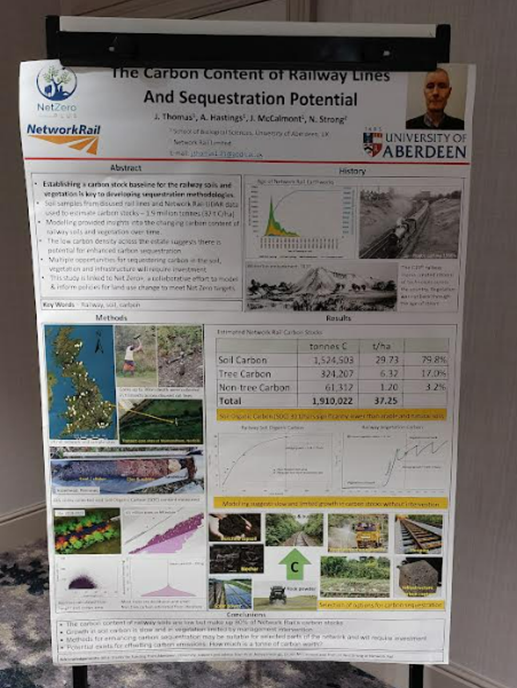
Justin Thomas, an early career researcher from the University of Aberdeen, recently attended the Rail Net Zero 2025 Summit, where he presented his poster on his research working with NetZeroPlus and Network Rail on The Carbon Content of Railway Lines & Sequestration Potential.
We are delighted to be able to share Justin’s key takeaways and reflections from the event below:
Justin's highlights and take aways:
The Net Zero Rail Summit was very good with speakers and attendees representing railway companies and suppliers from the UK and Europe. Key topics included initiatives to elimination emissions from traction mainly by replacing diesel with electrification, battery trains and biofuels (at least as an interim solution). The slow and intermittent pace of UK electrification was compared to Germany’s steady year-on-year progress. Improved measuring, monitoring and reporting of energy use and emissions was highlighted as critical to prioritising time and investment. There were several examples of energy and emission savings in the UK and Europe – notably Sweden’s railways which have reduced energy consumption from over 10% of the nation’s electricity output to about 1%.
Rail companies are having to react to climate change and more extreme weather events, and several speakers emphasised the importance of understanding the risks (flooding, heat, storm damage, drought & clay shrinkage) with close monitoring to identify and mitigate potential hazards before they impact operations. Nature based solutions can also play a part in adding resilience to railway networks. Railways play a role in ecology acting both as a barrier and a conduit for species – native and invasive. Sustainability was a key theme at the conference. Network Rail have targeted ballast, sleepers and rail for recycling and reuse. The importance of incorporating low carbon options, reuse and recycling enablers early in the design phase of any project was emphasised by speakers from the UK, Netherlands and France.
Long-term railway projects are set against a backdrop of largely public financing challenges and often political change and uncertainty which can make planning difficult and deter private investment. Several speakers spoke about the challenges of setting up monitoring and reporting systems for carbon emissions and sustainability. Others involved in the supply chain commented that there were missed opportunities in contractors not being involved early enough in project design and that the requirement for bids to include projections for emissions and sustainability were different for every company and could be quite onerous particularly for small companies and sub-contractors.
Demonstrating the potential for optimising carbon sequestration on rail land
As is often the case at conferences, the sessions acted as a catalyst for networking at the intervals and I had several productive conversations at my poster with people interested in my work on railway carbon stocks and potential methods for optimising carbon sequestration using rail land. I hope it will encourage companies to think about the possibilities that their land has to offer as they aim to get to Net Zero. I feel like I ought to end, hit the buffers if you like, with some terrible puns about an electrifying conference showing the industry was on track. But that would be crossing a line.
Justin Thomas, October 2025